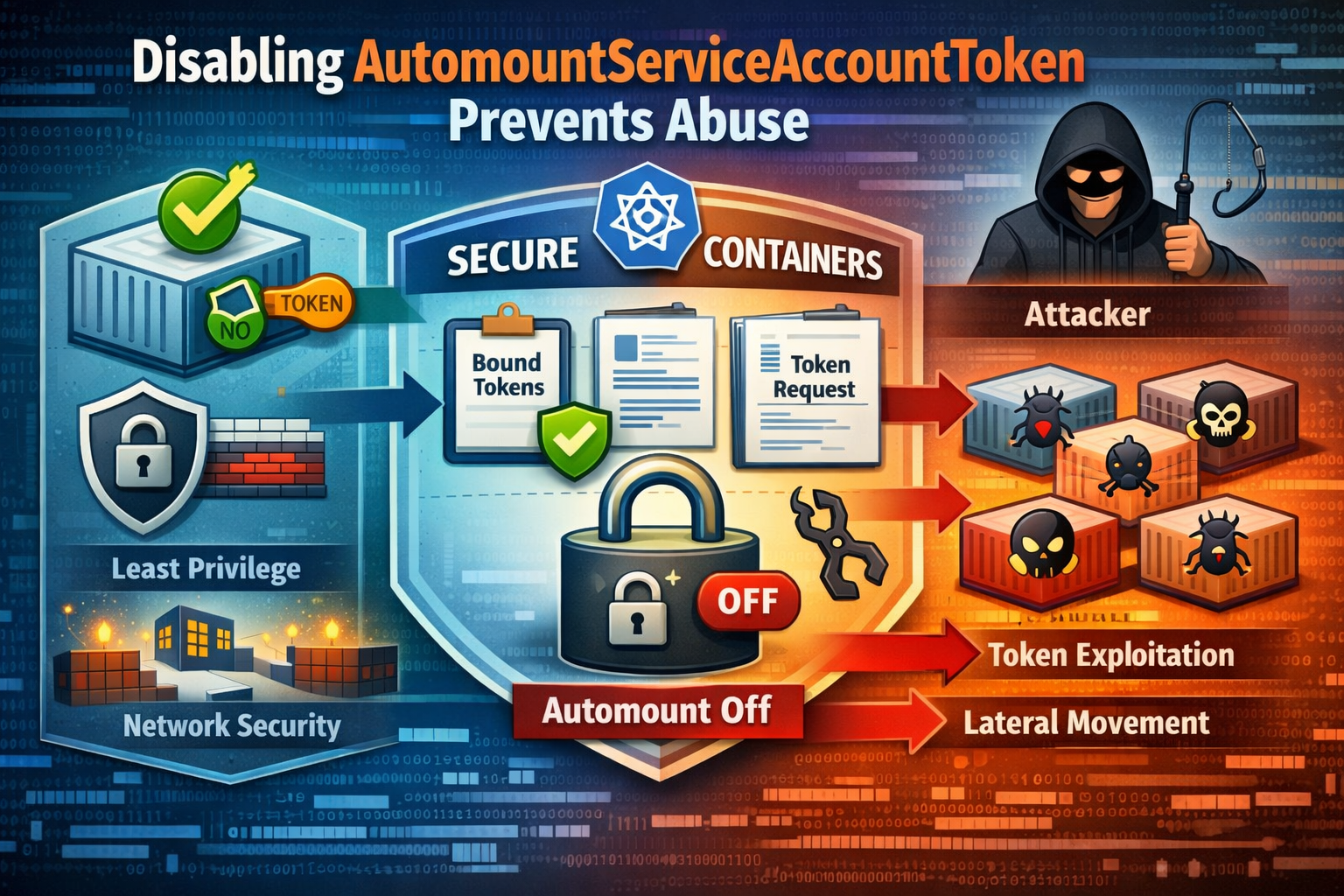
I’ve spent considerable time analyzing the attack surface within modern container orchestration platforms like Kubernetes native, GKE, and EKS. One area that consistently demands attention is service account provisioning – specifically, the default behavior of automatically mounting service account tokens inside each container. While convenient, this practice introduces significant risks. This post will delve into the evolution of Kubernetes service account security, reaffirming why disabling automountServiceAccountToken remains a crucial defense-in-depth measure for most production workloads.
The Original Risk: Automounted Service Account Tokens and Their Potential for Abuse
Back in November 2020, a blog post highlighted a concerning design choice within Kubernetes: the automatic creation and mounting of service account tokens into every container. These tokens, by default, granted access to the Kubernetes API server with and often have overly permissive rights within their respective namespaces. This created a prime opportunity for attackers who could compromise a single container to escalate privileges and wreak havoc across the cluster. The core issue stemmed from the fact that all pods within a namespace effectively operated at the same permission level as the service account, and these default service accounts were frequently granted broad read-write access for simplicity by admins & developers alike.
The ease of abuse was startling. With just a simple script or curl command, an attacker could leverage the mounted token to potentially create, delete, or modify Kubernetes resources; essentially taking control of the namespace.
KEP-1205: Bound Service Account Tokens – A Step Towards Mitigation
Fortunately, the Kubernetes community recognized this risk and began addressing it. Mike Danese (@mikedanese) and Shihang Zhang (@zshihang), within the SIG Auth working group, spearheaded efforts to improve service account security, culminating in KEP-1205: Bound Service Account Tokens.
This enhancement introduced an API that allows workloads to request JSON Web Tokens (JWTs) with specific constraints – audience binding, time binding, and eventually key binding. This is a significant improvement over the previous model where tokens were long-lived and lacked granular control. Instead of relying on pre-provisioned, broadly permissive tokens, workloads could now request short-lived tokens tailored to their exact needs.
The KEP outlines several key components:
- TokenRequest: A new resource defining the desired token attributes (audience, expiration).
- Token Attenuations: Mechanisms for limiting the scope of a token’s validity.
- API Changes: Modifications to existing APIs to support token requests.
- BoundServiceAccountTokenVolume: A volume projection that provides tokens on demand.
KEP-1205 fundamentally shifted the paradigm from provisioning tokens to requesting them, reducing the attack surface and improving security posture.
KEP-2799: Reduction of Secret-based Service Account Tokens – Further Enhancements
Building upon KEP-1205, Shihang Zhang proposed KEP-2799 – Reduction of Secret-based Service Account Tokens in June 2021. This enhancement aimed to address scalability issues and further minimize the attack surface associated with service account tokens. The core problem identified was the reliance on Secrets for storing and distributing tokens. Secrets, while useful, introduce complexities related to replication, access control, and potential exposure.
KEP-2799 proposed a new mechanism for token distribution that leverages bound service account tokens, eliminating the need for Secrets in many scenarios. This involved migrating from the existing admission controller-based approach to a more flexible and secure model based on token requests. The KEP also detailed considerations for safe rollout and backwards compatibility.
Why Disabling AutomountServiceAccountToken Remains Critical: Defense in Depth
Despite these significant enchancments (KEP-1205 and KEP-2799), disabling automountServiceAccountToken remains a best practice for the vast majority of production workloads. Here’s why:
- Principle of Least Privilege: Most containers do not require direct access to the Kubernetes API server. Automatically mounting a token grants unnecessary privileges, increasing the potential impact of a compromise.
- Defense in Depth: Layered security is paramount. Even with short-lived tokens and audience binding, reducing the attack surface by disabling automounting adds an extra layer of protection. If a container is compromised, the attacker will have one less avenue for escalating privileges.
- Network Policies: Complementary to disabling
automountServiceAccountToken, implementing robust network policies can further restrict access to the cluster API server from workloads that don’t require it. This creates a strong barrier against unauthorized communication. - Dedicated Service Accounts: Avoid using the default service account. Create dedicated service accounts with minimal permissions tailored to each workload’s specific needs. This limits the blast radius of any potential compromise.
In essence, these enhancements provide tools for secure token management, but disabling automounting is a fundamental security control that should be applied proactively.
Discovering Resources with an Automounted Service Account Token (Demonstration Purposes Only)
Disclaimer: This example demonstrates the risk and should only be used in controlled environments for educational purposes. Do not rely on this functionality in production without careful consideration of security implications.
The following Python code snippet illustrates how to use a mounted service account token to discover pods within the same namespace:
from kubernetes import config, client

# Load Kubernetes configuration (assumes running inside a pod)
config.load_incluster_config()

# Create a Kubernetes API client
v1 = client.CoreV1Api()

# Get pods in the current namespace
pods = v1.list_namespaced_pod(namespace="default") # Replace "default" with your namespace

# Print pod names
for pod in pods.items:
    print(f"Pod Name: {pod.metadata.name}")
This code leverages the kubernetes Python client library to automatically load the service account token from /var/run/secrets/kubernetes.io/serviceaccount and use it to authenticate with the API server. It then retrieves a list of pods in the default namespace. This simple example highlights how easily an attacker could discover sensitive information about the cluster if they gain access to a container with an automounted token.
How to Disable AutomountServiceAccountToken
At the ServiceAccount Level
Service Account Specification: You can disable automounting at the service account level:
apiVersion: v1
kind: ServiceAccount
metadata:
  name: default
  namespace: my-namespace
automountServiceAccountToken: false
Apply this manifest to each namespace, or use a kubectl one‑liner:
for ns in $(kubectl get ns -o jsonpath='{.items[*].metadata.name}'); do
  kubectl patch serviceaccount default -n $ns -p '{"automountServiceAccountToken":false}'
done
At the Pod Spec Level
Pod Specification: Add the following field to your pod specification:
apiVersion: v1
kind: Pod
metadata:
  name: nginx-no-token
spec:
  automountServiceAccountToken: false   # <- disables token mount
  containers:
    - name: nginx
      image: nginx:stable-alpine
Enforce via Admission Controllers
- OPA/Gatekeeper – Write a
ConstraintTemplatethat rejects pods withautomountServiceAccountToken:true. - Kyverno – Use a policy rule to mutate or validate pods, e.g.:
apiVersion: kyverno.io/v1
kind: ClusterPolicy
metadata:
  name: disallow-automount-token
spec:
  validationFailureAction: enforce
  rules:
    - name: require-token-off
      match:
        resources:
          kinds: ["Pod"]
      validate:
        message: "AutomountServiceAccountToken must be false"
        pattern:
          spec:
            automountServiceAccountToken: false
Attack Flow Diagram: Abusing a Service Account Token from a Compromised Container

This diagram illustrates the potential attack flow: a compromised container with an automounted service account token can access the Kubernetes API server. If the associated service account has excessive permissions, the attacker can escalate privileges and potentially compromise the entire cluster. If permissions are restricted, the impact is limited.
Conclusion
The evolution of Kubernetes service account security, from automatic token mounting to bound tokens and token requests, represents a significant step forward in protecting containerized workloads. However, disabling automountServiceAccountToken remains a critical defense-in-depth measure for most production environments. By embracing the principle of least privilege, implementing robust network policies, and utilizing dedicated service accounts, organizations can significantly reduce their attack surface and improve their overall security posture. Don’t rely solely on new features; proactively control access to your cluster resources.